

 Author:
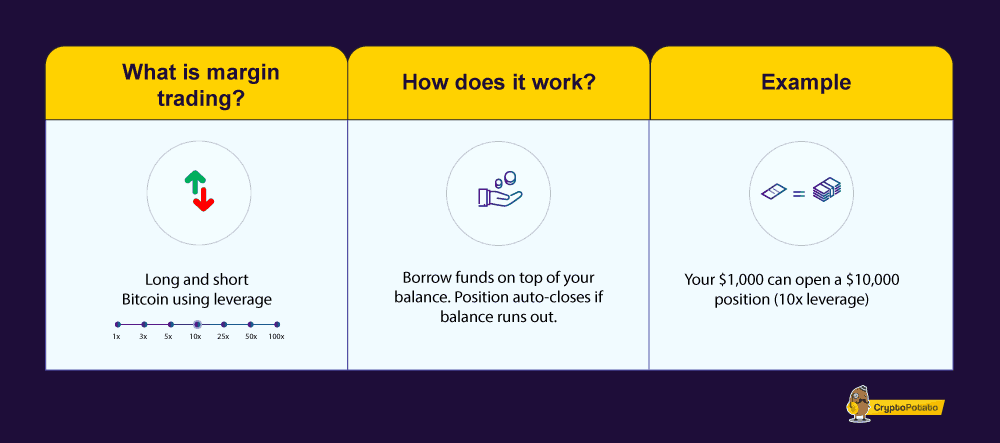
What if you could open trading positions with more funds than you actually had in your account? Imagine having $1,000 deposited but being able to effectively trade with $2,000, $3,000, or even $10,000.
Well, that’s entirely possible on many cryptocurrency exchanges and it’s called margin or leveraged trading.
Welcome to our how-to guide. In the following lines, you will learn what margin trading in Bitcoin and crypto is, how it works, top exchanges that enable margin trading, and most importantly – you will also learn some must-read tips before placing even the smallest margin position.
Quick Navigation:
- Bitcoin Margin Exchanges
- How to Short Bitcoin?
- Bitcoin Margin Trading Vs. Futures Trading
- Margin Trading Tips: Read Before Placing Orders
- Costs and Risks of Crypto Margin Trading
What is Bitcoin Margin Trading?
In this guide, we will mostly focus on Bitcoin margin trading because BTC is the largest cryptocurrency by market cap with the most considerable trading volume across all exchanges. However, the rules and tips hereby discussed apply to all supported altcoins for margin trading, i.e. Ethereum (ETH), Ripple (XRP), Solana (SOL) and more.
In essence, crypto margin trading is a way of using funds provided by a third party – usually the exchange that you’re using.
Margin trading amplifies the results of your trading in both ways – it can expand your profits, but it could also deepen your losses. This ability to multiply the trading results is what makes it very popular in low-volatility markets. Nevertheless, crypto margin trading is also very popular and enjoys a steady increase in its overall volume overtime.
For example, if we opened a Bitcoin margin position with a 2X leverage and Bitcoin had increased by 10%, then our position would have yielded 20% because of the 2X leverage. With no leverage, it would have been only a 10% ROI.
Margin leverage can also be 25X and even higher, despite the risk, the same position as described above would have yielded 250% (instead of 10% with no leverage).
Best Bitcoin & Crypto Margin Trading Exchanges
| Exchange | Pros | Rating | |
|---|---|---|---|
|
FREE $100
|
Futures & Perpetuals. Max margin 125x |
$100 voucher |
|
|
$7K BONUS
|
Futures & Perpetuals. Max margin 100x |
Up to $7K Deposit Bonus (CRYPTOPOTATO50) |
|
|
10% OFF
|
Futures & Perpetuals. Max margin 100x |
10% off fees |
|
|
$2K Bonus
|
Futures & Perpetuals. Max margin 100x |
Up to $2K Bonus |
|
Perpetuals. Max margin 100x |
|||
 Huobi Futures Huobi Futures |
Futures, Options & Perpetuals. Max margin 1000x |
Visit site | |
 Kucoin KucoinFutures |
Futures & Perpetuals. Max margin 100x |
||
 ApolloX ApolloX |
Perpetuals. Max margin 100x |
Visit site | |
 Delta DeltaExchange |
Futures & Perpetuals. Max margin 100x |
||
 Poloniex Poloniex
|
Derivatives. Max margin 2.5x |
||
 Plus500 Plus500
|
CFDs. Max margin 30x |
||
 Currency Currency
|
Derivatives. Max margin 20x |
||
 Bityard Bityard
|
Perpetuals. Max margin 100x |
||
 PrimeBIT PrimeBIT
|
Perpetuals. Max margin 200x |
||
 Bitfinex Bitfinex
|
Derivatives. Max margin 3.3x |
||
 Kraken KrakenMargin |
Derivatives & Futures. Max margin 5x/50x |


Show more
How Does Bitcoin Margin Trading Work?
In most cases, the user can borrow funds through the exchange, and these funds are either sourced by other users who earn interest or by the exchange itself.
This way, traders can increase their trading capital and open larger positions. The exchange doesn’t carry a lot of risks since every position has its liquidation price, which is based on the amount of borrowed margin.
How to Short Bitcoin and Other Cryptocurrencies?
Do you want to have the option to make gains while the Bitcoin price is decreasing? With margin trading, it’s possible. A short position on Bitcoin basically means that you bet that the BTC price will decline.
The way it works is quite simple. In essence, you Bitcoin at current prices, sell it and then rebuy later when the price drops. It may be a bit confusing, so let’s make an example.
Let’s imagine that Bitcoin is currently trading at $10,000, and you have $10,000 in your Binance margin account. Using this as collateral, you can borrow 2 BTC (for example) and sell it at current prices for $20,000. Now you have $10,000 of your own money and $20,000 of borrowed funds, and you have to repay 2 BTC to the exchange.
Your plan goes as intended, and the price of BTC drops to $8,000. You decide it’s time to make some profits. You buy 2 BTC (because that’s how much you have to buy back) for $16,000. Remember that you sold them for $20,000. This means that after you repay your loan (of 2 BTC), you will have $4,000 more in your account – welcome, those are your profits. Of course, that assumes there are no fees, but it’s also only for simplification purposes.
Cross Margin vs. Isolated Margin
On many exchanges, such as Binance Futures, users can use cross-margin and isolated margin modes.
The difference between both is the margin balance used to avoid liquidation. If cross-margin is enabled, the entire margin balance is shared across open positions to prevent liquidations. This means the trader risks losing their entire margin account’s balance alongside any open positions in the event of a liquidation.
Isolated margin refers to the balance that’s allocated to an individual position. This means that the trader can manage their risk on their individual positions by restricting the specific amount of margin that’s allocated to each one of them. If a position gets liquidated, it won’t affect the rest of the trader’s balance or their other open positions. It can also be adjusted individually.
Bitcoin Margin Trading Vs. Futures Trading
Many people commonly mistake Bitcoin margin trading for futures trading, but there are fundamental differences to keep in mind. We will break it down into sections to better differentiate between both types of Bitcoin trading.
Markets
With Bitcoin margin trading, users place orders to buy or sell directly in the spot market. This essentially means that all orders are matched with those in the spot market. With Bitcoin futures, traders place orders to buy or sell contracts in the derivatives market – they do not share the same orderbook, therefore, come with different liquidity.
Leverage
When trading Bitcoin futures, users can take advantage of very high leverage that would depend on the exchange but usually reaches up to (or even higher than) 100x. With Bitcoin margin trading, users have access to an average between 3x and 10x, depending on the platform.
Trading Fees
Since Bitcoin margin trading and futures take place on entirely different markets, the fees associated with both are usually different. Margin trading usually follows the fees of the spot market, whereas futures trading has fees based on the derivatives market.
Margin Trading Tips: Read Before Placing Orders
Since margin trading is risky, it’s not recommended for beginners. Therefore, if you’re new to this type of trading, we’ve prepared a few must-read tips to help you along the way. Keep in mind that this type of trading carries an amplified risk of losing capital, and you should never trade with funds that you can’t afford to lose.
Always start trading with small amounts
Is it your first day of margin trading? Even if it’s not, you should consider starting small. Get the necessary confidence and experience before jumping into the deep raging water of margin trading.
Don’t go all in at once
Even if you’re absolutely confident in your trading skills, it’s better to divide your positions into portions and create a ladder of prices. This way, you can reduce the risk while averaging down your entry price. The same is true for taking profit – you can set up a ladder to take profit on the way up.
Understand fees and liquidations
You must always know how much you pay for fees and what type of fees you pay for.
Margin trading comes with ongoing fees, so make sure they don’t end up eating up your entire profit or, even worse – your balance. The same is true for keeping tabs on your liquidation price – you must know that number in case the position starts approaching quicker than expected. This brings us to our next point.
Risk management
When trading on margin, set clear risk management rules and make sure to follow them. Don’t get greedy. Take into account the amount of money you are willing to risk, and always know that you can lose it entirely. Always use stop loss levels. This will prevent your entire stack from getting liquidated.
Price manipulations: short/long squeeze
The crypto markets remain, for large part, unregulated. It’s not out of the question to see the occasional short and long squeeze events, which also has to do with the current size of the market.
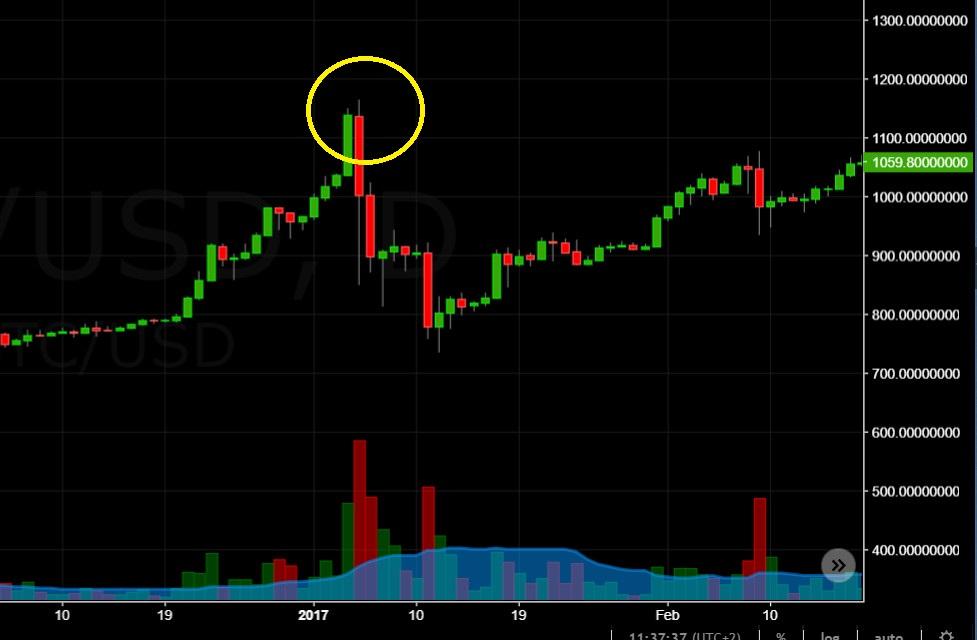
When the number of short or long positions is high, it means that a market participant can squeeze these positions by creating an opposing price move, forcing these positions into liquidation, or hunting their stop-loss orders.
Margin for short-term trading
Cryptocurrencies remain very volatile assets. Margin trading amplifies the risks associated with trading them even more. Therefore, try to make short-term (compared to spot trading or investment) margin trading positions and keep a constant look at them.
Moreover, remember that you’re paying ongoing fees for the borrowed margin, and even though the daily fees could seem negligible in the short term, they can quickly start to add up.
Pay attention to the fundamentals
Major events that surround the space, such as Bitcoin ETF decisions, SEC regulations, exchanges going under, and so forth, can have a significant impact on the price of BTC.
Even though traders tend to rely mostly on technical analysis, keep in mind that those events might have a critical impact on the market.
Under extreme volatility – don’t go away
Extreme price fluctuations are not uncommon when trading Bitcoin and other cryptocurrencies, and they take place in both directions. The risk associated with margin trading is that these wicks will touch your liquidation price and wipe out your entire position. The higher your margin, the closer the liquidation price.
Costs and Risks of Crypto Margin Trading
Even though you are technically using borrowed funds, you can’t end up owing money to the platform, as this would create a huge risk for the exchange itself. Therefore, the most you can lose is what your balance. This event, should it happen, is commonly referred to as liquidation.
The liquidation price is the point where the exchange will force-close your position automatically. Let’s see an example.
Imagine you had 1,000 USDT, and you used that to borrow 1,000 USDT more. Then you use the combined 2,000 USDT to buy BTC. If BTC drops to a point where you would lose your borrowed margin (the 1,000 USDT that you borrowed), the position will close automatically. And since 1,000 is exactly 50% of 2,000, your liquidation price will be 50% below your entry price.
That’s why we aid that the higher the margin you borrowed is, the closer your liquidation price will be to the entry price. It’s effectively the same as using leverage when futures trading.
As mentioned above, the costs of keeping a margin position active also includes paying ongoing interest for the borrowed funds, as well as the fees for opening and closing the position with the exchange. Keep in mind that as the chance to earn more increases, so does the risk of losing more.
Want to read more useful tips? Follow our 12 must-read crypto margin trading tips.


