
 Author:
Solana has one of the largest decentralized finance (DeFi) ecosystems in the crypto industry. The project recovered from the downfall of the FTX exchange in 2021 and made a massive resurgence in 2024, bringing notable developments and becoming one of the most popular networks in the industry.
Hosting multi-billion dollars worth of total value locked, Solana is home to hundreds, if not thousands, of projects.
Praised for its scalability, high speed, and low gas costs, the protocol has turned into the breeding ground for hundreds of decentralized applications (dApps), each serving diverse areas within DeFi: lending and borrowing, liquid staking, decentralized swaps, non-fungible token (NFT) collections, bridging crypto assets, derivatives trading, and much more.
Such a vast and diverse ecosystem of projects can seem overwhelming, leading you to ask yourself: How do I find new Solana projects? Or what is the best project on Solana?
This detailed guide attempts to answer these exact questions, looking at the top 10 Solana projects. Beyond an easy-to-understand explanation of the project, you will also find critical information on other important points, such as:
- The founders
- Funding rounds and notable investors
- Important project milestones
So, without any further ado, let’s dive in.
Quick Navigation
- The Importance of Solana DEXs
- The Top 10 Solana Projects in 2024
- Phantom Wallet: The Biggest Self-Custody Wallet on Solana
- Jupiter: Solana’s Top Decentralized Exchange
- Marinade Finance: Leading Solana Lending Project
- Magic Eden: Solana’s Go-To NFT Marketplace
- Dogwifhat (WIF): The Biggest Meme Coin on Solana
- Render Network: Decentralized Physical Infrastructure (DePIN)
- Ondo Finance: Real-Word Assets (RWA) on Solana
- Jito: Solana’s Liquid Staking Behemoth
- Kamino Finance: Leverage, Liquidity, Lending
- Mad Lads: Executable NFTs on Solana
- Helium Network: Internet of Things (IoT)
- Frequently Asked Questions
- Final Thoughts on the Top Solana Projects
The Importance of Solana DEXs
Decentralized exchanges (DEX) are arguably the heart of every DeFi ecosystem. DEX builders need infrastructure that’s scalable, cost-efficient, and especially fast for transaction processing.
It’s sufficient to say that Solana fits like a glove, as it’s the go-to blockchain for DEX developers seeking that type of chain.
That said, DEXs are a key driver of economic growth for the Solana ecosystem. By leveraging Solana’s blockchain, DEXs have managed to become DeFi giants, attracting users with innovative features like automated market makers (AMMs), liquidity provision, dollar cost averaging (DCA), perpetual trading, and much more.
Moreover, DEXs within Solana are important because they keep the ethos of decentralized money alive. They provide users with a main element—ownership and control of their assets through personal self-custody wallets.
If you still haven’t picked one, take a look at our detailed guide on the top Solana wallets. You can also watch our video here.
Given the importance of decentralized exchanges, we have decided to devise a dedicated guide on the best Solana DEXs.
Therefore, the following list purposefully doesn’t include many decentralized exchanges, although quite a few of them should definitely be considered top projects on Solana. And yet, because the guide would be misleading without including any, we will look into the biggest one.
The Top 10 Solana Projects in 2024
In this comprehensive list, we’ll explore the best Solana projects. We have considered factors such as market presence, standout features, community, and development team strength.
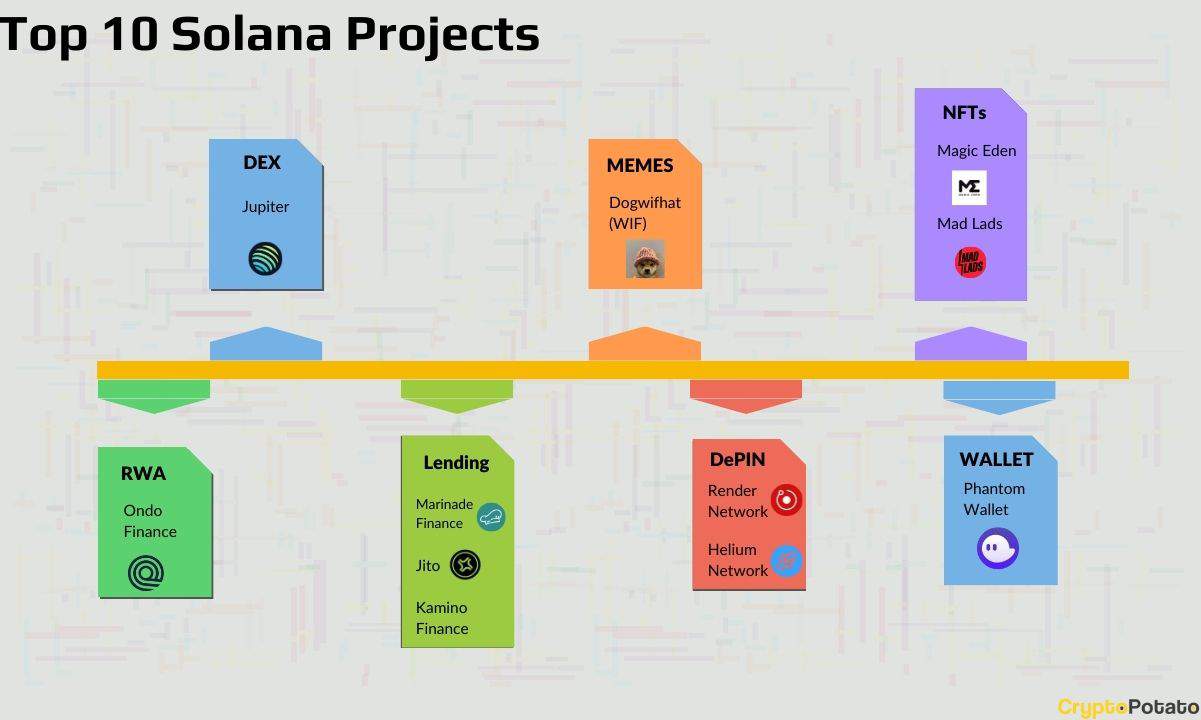
Here’s a short recap of the niches that we looked into and some of the projects in them:
Decentralized Exchanges: Jupiter
Lending: Marinade Finance, Jito, Kamino Finance
Wallets: Phantom Wallet
NFTs: Magic Eden, Mad Lads
DePIN: Render Network, Helium Network
RWA: Ondo Finance
Meme Coins: Dogwifhat (WIF)
Phantom Wallet: The Biggest Self-Custody Wallet on Solana
Quick summary:
- Largest self-custody wallet on Solana.
- Integrated support for other networks.
- Millions of monthly active users.
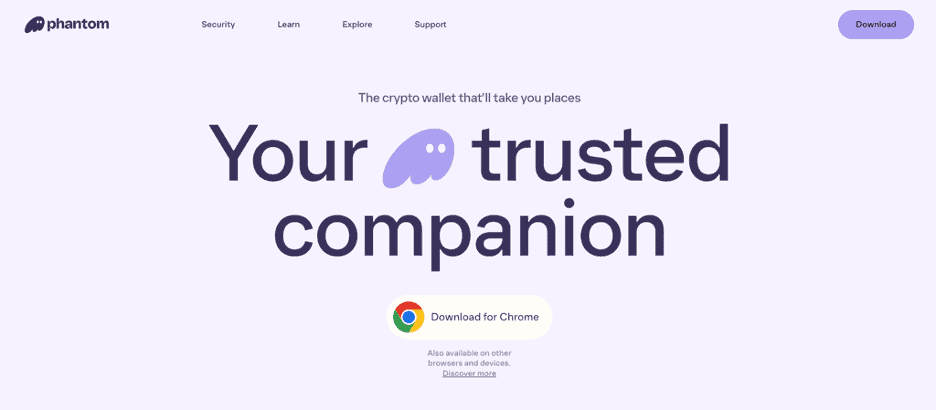
Phantom is hands-down the most popular self-custody wallet on Solana by means of total users. Launched in January 2021, the app has become one of the most widely used not only on Solana but across other networks as well.
It allows users to safely store their cryptocurrencies on-chain, catering to those looking for self-custody solutions. Almost all of the decentralized applications (dApps) on Solana support the Phantom wallet. It’s particularly popular among SOL stakers because of its simplified staking process and overall user-friendly interface, which makes it appropriate for hundreds of thousands of monthly users. It’s also available as a web browser extension for Brave, Google Chrome, and Firefox.
However, Phantom also has a dedicated mobile application that is supported on both iOS and Android devices.
CryptoPotato has conducted a couple of interviews with the CEO of Phantom – Brandon Millman, who’s also one of the co-founders. You can find them here and here.
Founders
Phantom was co-founded by:
- Brandon Millman – currently serving as the CEO.
- Francesco Agosti – currently serving as the CTO
- Chris Kalani – currently serving as the CPO
Funding
Data from CryptoRank shows that Phantom’s latest funding round in January 2022 valued the company at $1.2 billion. They raised $109 million. Before that, in July 2021, the company raised $9M.
Investors in Phantom include Paradigm, Jump Capital, Andreessen Horowitz, DeFi Alliance, Variant, Solana Ventures, and others.
Notable Milestones
- Raised over $100 million at a $1.2 billion valuation in January 2022.
- Extended support for Ethereum and Polygon in April 2023.
- Reported at 2.7 million monthly active users in January 2024.
Jupiter: Solana’s Top Decentralized Exchange (DEX)
Quick summary:
- Largest daily trading volume among Solana DEXs.
- Abundance of trading tools such as limit orders and DCA.
- Commitment to reward community.

As mentioned above, decentralized exchanges are at the forefront of Solana’s bustling ecosystem, providing a means for users to quickly swap between tokens without having to rely on their centralized counterparts.
Jupiter launched back in October 2021 and is one of the first on-chain swap aggregators on the networks.
Part of the reasons behind its success include important features such as limit orders, dollar-cost averaging (DCA), efficient swap services, and perpetual exchange capabilities (albeit still in BETA).
In January 2024, Jupiter launched its token – JUP. This was one of the most highly-anticipated airdrop campaigns in the cryptocurrency industry, which further highlighted the team’s commitment to rewarding its community.
This approach, firmly coupled with the team’s overall approach toward innovating and delivering practical and functional trading tools, has cemented Jupiter as one of the top projects on Solana and a powerhouse in the field of decentralized trading.
Founders
The founder of Jupiter is pseudonymous, using the X monicker Meow. Ben Chow is the co-founder.
Funding
Jupiter conducted an airdrop in January 2024. According to its tokenomics, 20% of JUP is reserved for team members under a specified vesting schedule. There’s also a 20% strategic reserve, which is managed by the team.
Notable Milestones
- Outperformed OpenSea on multiple occasions in 2024.
- Conducted one of Solana’s largest airdrops, launching the JUP token.
- Introduced limit orders, DCA, and other features.
Marinade Finance – Leading Solana Lending Project
Quick summary:
- Occupies the lending field.
- Focuses on liquid staking on Solana.
- Largest lending protocol on Solana.

Marinade Finance is one of the biggest projects in Solana, with a total value locked surpassing $1.5 billion (April 2024).
The protocol allows users to stake their SOL tokens and, in exchange, receive mSOL, which is the tokenized version of their staked assets. This means that while stake assets accrue yield and contribute to the network’s security and liquidity, users can deploy the mSOL tokens in other DeFi applications to maximize their income.
Users can unstake at any time without needing to wait. Moreover, accessibility to the protocol is not an issue, given that it’s integrated with exchanges like Coinbase and Solana-based wallets like Phantom.
Marinade quickly became one of the topSolana projects after capitalizing on the liquid staking narrative alongside protocols like the Ethereum-based giant Lido. After losing nearly 90% of the TVL in its network following the bearish grip that took over the crypto market from late 2021-2023, Marinade gained momentum 2024, amassing billions in total value locked (TVL).
Founders
Marinade Finance was founded in 2021 by Marco Broeken and Lucio Tato. Little information is available about the duo, mostly because the project is run by its decentralized autonomous organization (DAO).
Funding
The exact amount Marinade Finance has raised is not publicly available. However, PitchBook reveals that Marinade completed at least one funding round and has secured investment from two VCs: Miton and Big Brain Holdings.
Notable Milestones
Important milestones for the protocol in 2024 include reaching over 160+ validators and the rollout of important developments. Some of them are:
- The rollout of Protected Staking Rewards in Q1, 2024, which allows Marinade to stake to more than its fleet of 100+ validators, further supporting decentralization on Solana.
- Improved TX performance for the dApp.
- The rollout of new marketing strategies to build new partnerships and push institutional adoption of Marinade’s growing product suite.
Magic Eden: Solana’s Go-To NFT Marketplace
Quick summary:
- Occupies the NFT space.
- Offers support for Ordinals, Ethereum, Polygon, Base.
- Largest NFT marketplace on Solana.
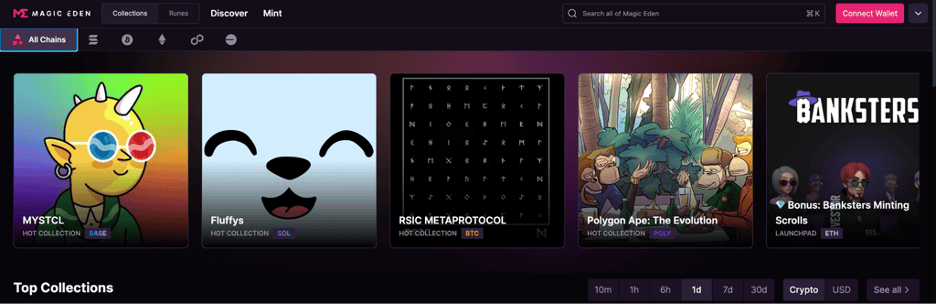
Solana’s non-fungible tokens space has been booming since 2021 and one of the largest marketplaces and the go-to platform for many NFT traders and investors is Magic Eden.
Magic Eden was launched in September 2021, and it quickly became dominant in the broader Solana ecosystem.
The platform is primarily known for providing users with a means of trading non-fungible tokens, but it’s also a place where one can launch their own collection. Magic Eden charges a certain tax on each NFT transaction.
It started as a Solana-focused NFT marketplace but later expanded to other networks. Although far from being as popular as the ETH-based NFT platform OpenSea, Magic Eden does offer support for Ethereum.
The project is also known for the team’s ability to adapt, launching support for trending networks quicker than many others. Some of these networks include Bitcoin (Ordinals and Runes), Polygon, and Base.
Founders
- Jack Lu – who currently serves as the CEO
- Sidney Zhang – who currently serves as the CTO
- Zhuoxun Yin – who currently serves as the COO
- Zhoujie Zhou – who currently serves as the Chief Engineer
Funding
Magic Eden has had three funding rounds:
- Seed – raised $2.5 million in October 2021.
- Series A – raised $27 million in March 2022.
- Series B – raised $130 million in June 2022.
Some of the notable investors include Paradigm, Solana Ventures, Sequoia Capital, Electric Capital, 6th Man Ventures, and others.
Notable Milestones
- Raised $130 million at a $1.6 billion valuation in June 2022.
- Extended support for Bitcoin Ordinals in March 2023.
- Surpassed OpenSea and Tensor in terms of transaction volume in April 2024 (temporary).
Dogwifhat (WIF): The Biggest Meme Coin on Solana
Quick summary:
- The dog still has its hat.

Meme coins on Solana became one of the hottest topics in late 2023 and early 2024. Trading volume on the protocol exploded, causing the network itself to experience clogging issues and even downtime.
One of the most impactful meme coins in the entire industry, not just Solana, has undoubtedly been Dogwifhat (WIF).
The name describes a dog belonging to the corgi breed wearing a simple pink hat – hence, dog wif (with) hat. It became popular within tighter Solana-focused communities in December 2023 but exploded into the mainstream in the months that followed. By March, WIF was already trading at multi-billion dollar market capitalization, venturing into the top 50 cryptocurrencies in this list.
The coin has absolutely no utility or purpose beyond being funny. The joke is that no matter what happens, the dog will still have its hat.
Founders
The founders of Dogwifhat are anonymous, and they are known to have sold their tokens well before it became a popular meme coin.
Funding
Dogwifhat has received no funding – it’s a meme coin.
Notable Milestones
- Went parabolic in 2024.
- The community raised $650K to put the dog on the popular Las Vegas Sphere.
- The dog still has its hat.
Render Network – Decentralized Physical Infrastructure (DePIN)
Quick summary:
- Occupies the DePIN Narrative.
- Focuses on decentralizing GPU cloud rendering.
- Multiple applications in various fields.
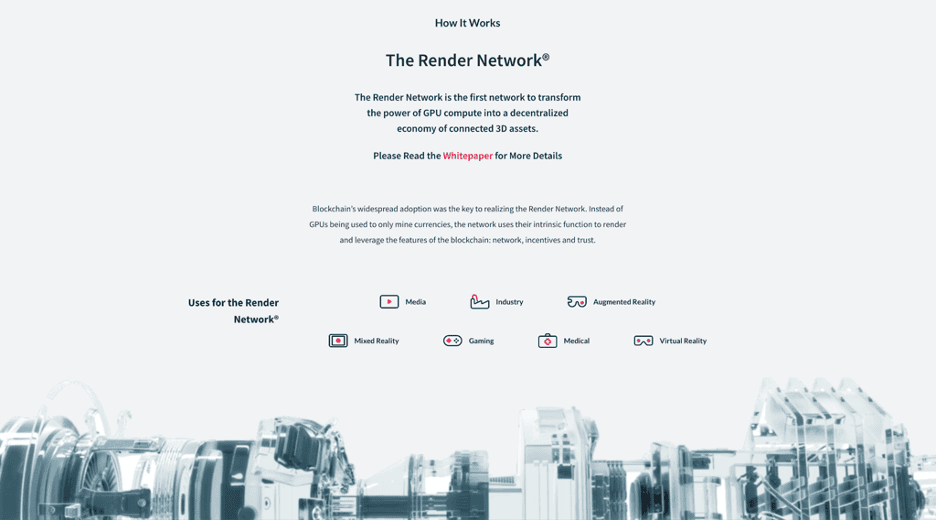
Render Network (RNDR) is one of the most popular projects in the Solana ecosystem. It aims to decentralize GPU cloud rendering through a marketplace linking users in need of on-demand rendering with high-performance GPU owners. This model empowers artists, individuals, and businesses to efficiently scale rendering tasks at a lower cost and faster pace compared to centralized GPU cloud systems.
The business model relies on two main actors: creators, who submit rendering jobs, and node operators, who leverage spare GPU capacity to fulfill tasks and earn RNDR as compensation. However, Render Network is capable of much more. Tasks within the platform range from simple rendering assignments for gaming, entertainment, or art to more intricate requests for artificial intelligence (AI) or machine learning (ML) applications.
Founders
Jules Urbach founded Render Network in 2017. Urbach is also the founder of OTOY, a cloud GPU rendering service for content creation and delivery media. He’s considered a pioneer in computer graphics, streaming, and 3D rendering with over 25 years of industry experience.
Other notable team members are Bitcoin investor and tech entrepreneur Kalin Stoyanchev, who’s Render Network’s Project Lead, and CTO Charlie Wallace, a renowned software engineer.
Render Network also boasts a notable advisory team composed of high-profile names in multiple industries, including the well-known cineast J.J. Abrams; Jennifer Zhu Scott, a deep tech-focused entrepreneur from Hong Kong; and Ariel Emanuel, CEO of Endeavor, a global sports and entertainment company.
Funding
Render Network completed one round of fundraising. According to CoinCarp, the protocol brought in $30 million from a Seed round on December 21, 2021, from venture capital firms like Multicoin Capital and Solana Foundation and angel investors like Vinny Lingham.
Notable Milestones
Render Network was one of the best-performing DePIN projects of 2023. That year, the protocol witnessed a notable surge in demanding rendering tasks. This surge, fueled by advancements in next-generation projection mapping and immersive rendering projects, led to the highest workload volumes since the Render Network’s inception.
Render Network is now the largest DePIN project, with a market capitalization of over $3.3 billion (as of April 2024).
Ondo Finance – Real-World Assets (RWA) on Solana
Quick summary:
- RWA narrative on Solana.
- Institutional-grade on-chain products.
- Focus on compliance.
Ondo Finance is an RWA protocol that brings institutional-grade products on-chain. This means securities like bonds and treasury are tokenized on the blockchain to provide multiple benefits to investors, such as the ability to trade on secondary markets without typical wait times and bureaucratic hurdles, hence enhancing efficiency and liquidity.
Ondo provides a compliant and regulated trading avenue for investors who wish to engage with tokenized assets. However, it requires users to undergo KYC (Know Your Customer) procedures before joining the network. This is to ensure compliance with regulatory laws.
Operating on the principle of self-sufficiency, Ondo achieves this through partnerships and integrations with asset managers, custodians, lawyers, and other entities necessary for on-chain asset management.
Founders
Ondo was founded in 2021 by Nathan Allman, who previously worked on Goldman Sachs’ digital assets team. Other members include former Goldman Sachs and McKinsey & Co. executives, such as Ian De Bode.
While it deviates from the usual anonymity and privacy-focused DeFi protocols, Ondo and other RWA protocols are one of the main drivers of blockchain adoption and economic growth for blockchain ecosystems. By logic, Ondo wouldn’t be able to offer tokenized bonds, which are securities, if it doesn’t provide the necessary steps to comply with regulatory laws.
Funding
Ondo Finance has raised around $46.4 million in one public sale ($22.4M) and a Series A ($24M) funding round.
Notable Milestones
Ondo Finance moved $95 million into BlackRock’s tokenized fund, BUIDL, on April 2024. This will enable instant settlements for Ondo Finance’s OUSG, which are tokens backed by short-term government treasuries.
Another recent milestone for the project is partnering with the Cosmos-based Nobloe chain to bring tokenized products to the Cosmos blockchain. The first asset that Ondo plans to issue through Noble on the Cosmos platform is USDY, a tokenized note backed by short-term U.S. Treasuries that offers a 5.2% annual yield. It’s expected that Q2 of 2024 will be the date for its issuance.
Expanding to the Cosmos ecosystem means that Ondo’s token offerings will become accessible across more than 90 blockchains interconnected through Cosmos’ Inter-Blockchain Communication Protocol (IBC). This integration is expected to enhance the adoption of Ondo’s products, including assets for earning yields, making payments, and acting as collateral.
Jito – Solana’s Liquid Staking Behemoth
Quick summary:
- Liquid staking on Solana.
- Hosted one of the most trending airdrops.
- Leverages MEV strategies.
Jito is one of the most important liquid staking protocols in the Solana blockchain. It stands out from other protocols due to its simplicity of use and user-friendly dashboard.
One reason for Jito’s success is its approach to MEV frontrunning.
MEV (Maximal Extractable Value) is a controversial topic within the crypto industry. Some users argue that MEV miners manipulate markets to front-run trading orders on decentralized exchanges or reorganize transactions within a block to prioritize those that can net higher profits. This leads to an unfair advantage by exploiting positions in a given network and, overall, a worse experience for general users.
Others argue that MEVs can make markets more efficient by finding the best prices for tokens across exchanges and mitigating economic inefficiencies across DeFi protocols, especially in lending protocols, in which MEV can help lenders get paid back when borrowers fail to meet a specified collateralization threshold.
In general terms, there are positive and negative sides to MEV, and that’s where Jito kicks in. The solution for Jito was to provide an auction system that allows traders to bid on transaction sequences they deem profitable. Then, third-party block engines conduct simulations to find the most valuable transaction combinations.
The resulting bids are distributed to validators and stakers through JitoSOL. This mechanism effectively removes spam benefits while enhancing staker rewards.
Founders
Jito was founded by Jito Labs, whose co-founders are Lucas Bruder, CEO, and Zano Shermani, CTO.
Prior to co-founding Jito Labs, Lucas specialized in robotics control systems for autonomous bulldozers and embedded firmware development at Ouster and Tesla.
On the other hand, Shermani served as a Software Engineer at Parsec and pursued his education at George Mason University.
Other notable names include Brian Smith, the COO of Jito Labs and a core contributor to the JIto Network.
Funding
In 2022, Jito Labs raised $12 million in a Series A round led by Multicoin Capital and Framework Ventures.
Notable Milestones
- Jito has become a household name in the Solana ecosystem. The total value locked within the protocol has surged in Q1 2024
- Jito distributed its token through a massive airdrop on December 7th, 2023.
Kamino Finance – Leverage, Liquidity, Lending
Quick summary:
- Occupies lending, liquidity, and leverage fields.
- Provides a number of features for many needs.
- Rewards users through Kamino points.
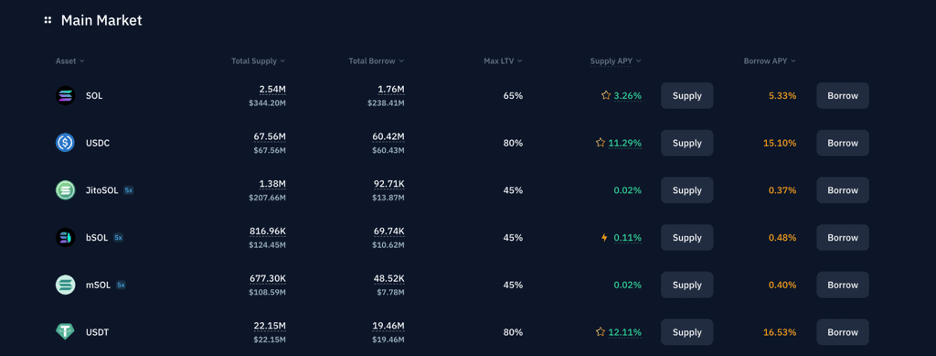
Kamino Finance is one of the most interesting projects on Solana due to its large suite of products for lending, borrowing, and investment opportunities.
Established in 2022 and headquartered in London, England, Kamino has made its way to the top Solana projects due to its diverse range of decentralized financial services, mainly liquidity provision, leveraging, and lending and borrowing.
The Multiply feature has helped Kamino to become more appealing to users. As the name suggests, Multipliers allow users to increase their exposure to a yield-generating asset by borrowing the underlying asset.
For example, a user could borrow SOL to increase their exposure to JitSOL. This is thanks to Kamino Lend, which means Multiply positions are essentially overcollateralized loans wrapped into a more user-friendly UI.
Kamino Points are also an integral part of the platform. Since announced, points have served as a reward and incentive mechanism, encouraging user engagement across borrowing, lending, and liquidity vaults. This system has played a pivotal role in Kamino’s growth as it serves as the accounting measure to gauge which users will be rewarded best in any upcoming airdrops.
Founders
Gonzalo Parejo Navajas and Ben Gleason founded the protocol. Navajas previously worked as an Operating Partner at Niche Partners. He co-founded OnTruck, a merchandise transport service, and was managing director at tech and shipment company iContainers.
Meanwhile, Gleason was the CFO and Managing Director of e-commerce Groupon LATAM. Prior to that, he served as Engagement Manager at McKinsey.
Funding
Kamino secured over $10 million in funding, with backing from prominent VCs like Solana Ventures and Jump Capital.
Notable Milestones
Kamino has become the largest USDC venue in Solana, with over $180 million in its USDC products.
Kamino’s ambition goes even further; the protocol partnered with Jito and DeFi research firm Gauntlet to fuel USDC adoption on Solana, starting with $140K monthly incentives across three products.
Mad Lads: Executable NFTs on Solana
Quick summary:
- Occupies the NFT space.
- Created and developed by an established infrastructure developer.
- Is mad, lad.
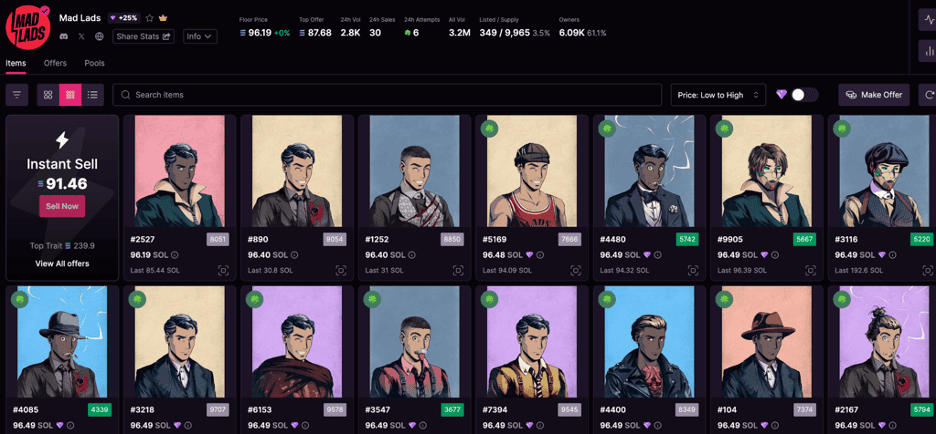
Mad Lads has become one of the biggest collections of non-fungible tokens on Solana.
It was launched by a company called Coral. It’s focused primarily on Solana framework development.
The collection itself is made out of 10,000 unique avatars. They depict humanoid characters, each one of which comes with specific attributes that vary in rarity. The more rare an NFT is, the more expensive it typically is.
Approximately 9,966 of the Mad Lad NFTs have been minted and held by collectors. It’s worth noting that there are no two exact pieces – each one of them is unique in its own shape and form.
One of the more interesting features about Mad Lads is that they are xNFTs. This means that there’s a code script written in them that can be executed by an app that supports Mad Lads. In essence, this means that they are programmable and easily integrated withing third-party applications.
Founders
The project was founded by Coral. The founder of Coral is Armani Ferrante – a tech professional who started his career in Apple.
Trystan Yver is a co-founder of Coral.
Funding
Coral received a $20 million funding round in September 2022.
Notable Milestones
- The Mad Lads peaked in December 2023, reaching an all-time high floor price of around $20K.
- Largely recognized as one of Solana’s “blue chip” NFT collections.
Bonus: Helium Network – Internet of Things (IoT)
Quick summary:
- Occupies the DePIN narrative
- Focuses on distributed hotspot network
- Uses Proof of Coverage (PoC)
Helium Network is another DePIN project that migrated to the Solana blockchain in order to become a leader in decentralized wireless infrastructure.
Hotspots are the fundamental pillars of the Helium ecosystem. When you activate and run a hotspot, you provide individuals and businesses in a nearby area with internet access compared to cellular data. For that, you are rewarded with HNT — the protocol’s native token.
The Helium Network operates on Proof of Coverage (PoC), a unique algorithm that incentivizes users to verify network coverage, thus confirming their location and connectivity. PoC is integrated into the Helium Consensus Protocol, which utilizes the HoneyBadgerBFT consensus protocol.
The business model is pretty straightforward: users deploy Hotspots to contribute to the Network and earn Helium mining rewards through an incentive system facilitated by the Helium blockchain. Helium mining leverages radio wave technology rather than traditional mining methods with GPUs or ASIC rigs, significantly reducing energy consumption.
Founders
Helium didn’t start as a crypto project. It was launched in 2013 as a telecommunications company under the name Helium Inc., founded by Amir Haleem, Shawn Fanning, and Sean Carey. It was in 2019 that the founders pivoted to crypto. Success didn’t take long, as the Helium network went from hosting 20,000 hotspots globally in 2019 to over a million by February 2021.
Funding
Helium is one of the top-funded crypto projects in the industry, amassing over $364 million from over 33 investors. Prominent names that have invested in this project are Google Ventures, FirstMark, Pantera Capital, and Munich Re Ventures.
Notable Milestones
Helium has showcased the utility and innovation of DePIN and decentralized wireless infrastructure through a series of partnerships and adoption by major entities. For instance, in January, Spanish multinational telecommunications company Telefónica partnered with Nova Labs to deploy Helium-powered 5G hotspots across Mexico City and Oaxaca. This allows Telefónica to offload data traffic from traditional cellular networks onto the Helium 5G network.
Frequently Asked Questions
What is the best project on the Solana blockchain?
The best project on the Solana blockchain varies depending on the niche and your expectations. There are a lot of reliable teams building really exciting infrastructure on Solana, as well as a lot of creators delivering some incredible digital art in the form of NFTs.
How do I find new Solana projects?
The best way to find new Solana projects is to get involved with already-established communities and create a network of like-minded individuals who will help you on your journey. Remember, four eyes on the market are always better than two.
Is Solana still popular?
Solana remains one of the most popular networks in the cryptocurrency industry, having surged in user interest in 2023 and 2024.
Final Thoughts on the Top Solana Projects
Solana has become a hub for a diverse ecosystem of decentralized applications (dApps), particularly in areas like lending, liquid staking, decentralized exchanges (DEXs), and real-world asset tokenization.
Despite all the obstacles, Solana made a remarkable resurgence in 2024. Its decentralized finance (DeFi) ecosystem boasts billions in total value locked (TVL), showcasing its resilience and attracting attention for its scalability, speed, and cost-efficiency.
This has been propelled by promising teams building high-quality projects such as the ones mentioned above.
LIMITED OFFER 2024 for CryptoPotato readers at Bybit: Use this link to register and open a $500 BTC-USDT position on Bybit Exchange for free!


